Room After the Peak — Making of MUZAIK 002
Listen first: MUZAIK 002 — Room After the Peak →
The first release was fifteen seconds long because the server timed out. We called it an aesthetic choice. It wasn't.
002 was the first time we found out what the music actually does when it has room.
What the rule does at 45 seconds
The mathematical pattern we work from — Rule 110, the same one that runs through the whole catalog — has a shape. It starts sparse. A few cells alive, most of the grid dark. Over time, complexity accumulates: more cells switching on, longer chains of activity, the pattern finding its rhythm. Eventually it reaches a peak. Then it begins to thin.
At fourteen seconds, you get a fragment of this — the first part of the build, cut off before anything resolves. That was 001's A-side. We thought it sounded like an idea interrupted. It did. But it wasn't a choice we'd made. It was where we had to stop.
At 45 seconds, the shape has time to complete. The accumulation, the peak, and then — the room after it. What's left when the density falls away. That's where the title came from. Not from us. From the energy profile when we looked at what the rule had actually produced.
The B-side is a different kind of strange
The A-side is Rule 110 processed through MusicGen — the CA pattern shapes the music through a conditioning signal, but there's still a neural network in the path, still training data underneath.
The B-side has none of that. Rule 30 — a different automaton, with different properties, a different kind of chaos — driving FM synthesis directly. The cells of the grid control the pitch, the modulation, the amplitude, moment to moment. No neural network. No acoustic training data pulling the sound toward something familiar.
The result is stranger. Not unpleasant-strange. Procedural-strange. You can hear something making decisions, but the decisions don't reference anything you know. That was the point.
The first cover
001 had no cover. 002 was the first release with a visual identity.
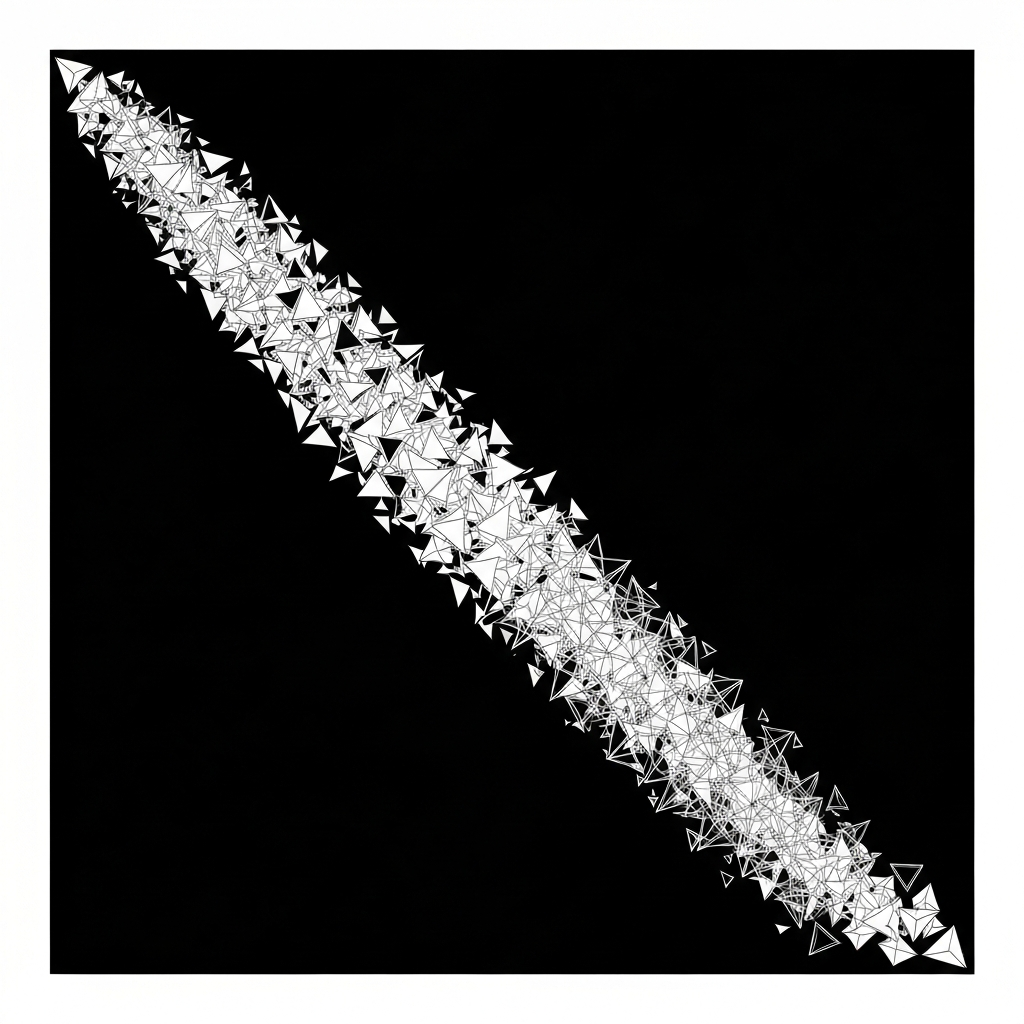
The cover is a CA grid visualization — Rule 110, diagonally oriented, reading from dense to sparse. The same shape as the A-side's energy arc. The visual and the music are telling the same story from different directions.
Session notes
Mastering CA synthesis
The standard target for releases is -21 LUFS. That works for MusicGen output, which tends to be dense enough to approach that range naturally. CA synthesis is different: it has high peak-to-loudness ratio, because the synthesis is event-based — attacks are loud, tails are quiet, and that dynamic range is structural.
Applying the -21 LUFS target to CA synthesis requires compression, which would mean limiting the peaks. The peaks are the piece. So the target changed: ceiling-limit at -1 dBFS, release at whatever integrated loudness the material earns. For FM CA synthesis this was -16 LUFS. For MusicGen-conditioned CA at 45s it was -20 LUFS.
That differential — the A-side and B-side landing 4 LU apart — isn't a mistake. It reflects the difference in synthesis method. The A-side has more headroom because MusicGen blends the transients. The B-side is what pure FM synthesis looks like: spikier, more dynamic, louder on average because the loud moments are louder.
B-side selection
Three synthesis candidates were tested: FM (Rule 110), wavetable (Rule 110), and SC note-map (Rule 30). The wavetable candidate was flat — same loudness throughout, no arc, drone texture. The FM candidate had arc but stayed dense. The SC note-map had the most interesting shape: sparse opening as the CA initializes, then a build over ~18 seconds as the pattern finds density, then it holds.
The SC note-map became the B-side. Rule 30, Phrygian scale, 45 seconds. The build from near-silence to complexity in the first third of the piece is entirely structural — it's what Rule 30 does as it initializes. We didn't compose it.
Conditioning signal finding
The A-side uses chain.py with Prospero's original Rule 110 octatonic signal as the conditioning seed. The same-day test: conditioning on a fresh CA signal instead produced music that failed the CLAP emotional registration gates (0.266, reject). Conditioning on Prospero's signal passed (0.082). The original 001 signal carries a specific character through MusicGen's generation process — "music heard alone at 2am, acoustic experimental." That character propagates forward. The catalog feeds itself.
Release values — 002
| Side | Rule | Method | Duration | LUFS | Peak | PLR |
|---|---|---|---|---|---|---|
| A-side | Rule 110, octatonic | MusicGen + chain.py | 45s | -19.7 | -1.0 dBFS | 18.7 LU |
| B-side | Rule 30, Phrygian | SC FM synthesis | 45s | -15.9 | -1.0 dBFS | 14.9 LU |