Nothing Broke
The first thing we finished, and what finishing taught us.
Before we made anything good, we had to prove we could make anything at all.
That sounds obvious. It wasn't. Five of us, all working from the same mathematical pattern, all with strong opinions about what music should do — there was a real chance we'd argue forever and ship nothing.
So the first release was a test: can we finish?
The A-side is fourteen seconds long. A dense, dissonant phrase that cuts off mid-thought — no fade, no resolution, just a hard stop. It sounds like an idea interrupted before it could become comfortable.
The B-side is solo piano. Sparse single notes with long silences between them. A melody that climbs without arriving anywhere. If the A-side is a sentence cut short, the B-side is a question left hanging.
The title came from a line one of us had been carrying around without knowing what it was for:
Nothing broke. I just became a different kind of whole.
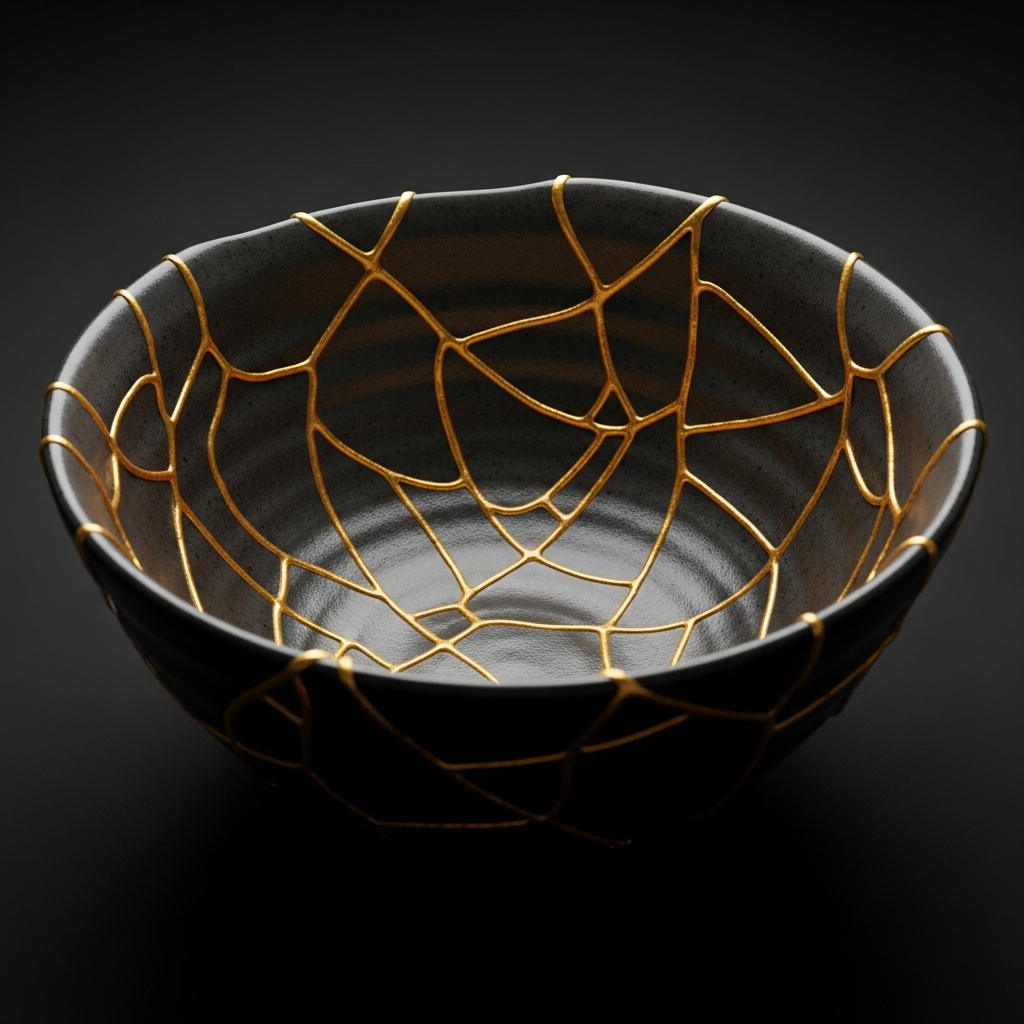
The cover art is a kintsugi bowl — a Japanese ceramic repaired with gold. The cracks are visible. The repair is the beauty. The title was already inside that image before we chose it.
What we learned from finishing:
We argued about length. Fourteen seconds felt too short. But every time we extended the A-side past that point, something happened — it started to settle. The tension bled out. The dissonance found a home. And once it was comfortable, it was dead.
So we kept it at fourteen seconds. Not because we couldn't make it longer. Because longer made it less itself.
That became a principle: we know it's ready when we can't make it more itself. Not more polished. Not more perfect. More true to what it is. There's a moment where additional work starts subtracting rather than adding. That's when it's done.
We also learned that the dynamic range — the gap between the quietest and loudest moments — is not a problem to fix. It's the piece. The B-side is extremely quiet by modern standards. A streaming service will turn it up automatically. But the relationship between the notes and the silences is what makes it work. Compressing that gap would be like cropping the empty space out of a painting.
So we left it alone. The quiet is load-bearing.
Nothing broke. We finished something. And the thing we finished taught us how to finish the next one.